
Pug Skin Issues
Overview
It seems that owners often concentrate on a Pug dog’s coat, since it is dense and sheds a lot. However, one must also pay attention to their Pug's skin.
In this section, we will discuss:
- The issue of loose skin
- Common medical issues that may affect the skin and/or coat
- Odor issues
- Proper care and cleaning
Please note:
PetPugDog is reader-supported, and some of the product suggestions on this page may be affiliate links. As an Amazon Associate we earn from qualifying purchases. This is at no extra cost to you and helps keep this site running.
Elasticity
Do you wonder why a Pug has loose skin? This characteristic is commonly seen with breeds that were initially bred for fighting (the loose skin was intended to offer protection).
However in looking at the history of the breed, the Pug was only used minimally in the military and as guard dogs. He was geared toward being a lap dog and primarily owned by those in the upper class. So while this trait is a genetic trait, it is thought that it is simply for aesthetic purposes only.
Careful and purposeful development of the breed over generations gives us a dog today in which the skin is minimally loose over the body, moderately on the upper body and majorly loose on the head and facial area.
The Head and Face
- Breed standards dictate that the folds on the head should be 'large and deep'. The reason that the skin is loose on the forehead is because the skull does not have prominent skeletal brow ridges. This breed was developed to not have this feature as it was intentionally bred to have a compressed face and skull.
The Body -
Pugs will vary in regard to how much loose skin is over the body. It is normal for Pugs to have much more looser skin on the upper portion of the body than the lower. It is common for it to be loose:
- Around the base of the head
- Coming down the neck
- The chin area, often hanging down distinctly loose
- Across the chest
- Over the top half of the back
Puppies may somewhat
grow into their skin; during the first year of growth there will be pronounced muscle development which allows the dog to fill out. For some, the skin across the back and chest will tighten up a bit.
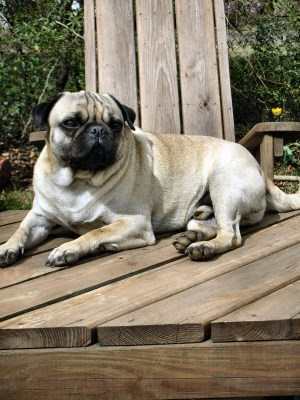
Depending on the Pug dog, there may or may not be enough excess skin for the dog to have folds (aside from the face). If he does, this is most noticeable on the neck, shoulder and chest area. It is also normal for a Pug to have some bunching of the skin across the top of his back when he sits down.
As a Pug ages and matures into a senior there can be a gradual loss of muscle mass that in turn causes the skin to appear looser.
Those that have chronic problems of yeast infections and other skin issues may be candidates for surgery that removes excess skin in problem areas.
Demodectic Mange
This is most often seen in puppies, although it can develop in an older dog. It is caused by a particular mite, called the Demodex mite. When this almost microscopic pest invades your Pug, it will affect the skin which then leads to
fur loss. Patches of the coat may fall out, this can happen in just one particular location or several across the body.
As the hairs fall out and areas become thinner, you will often notice that the skin underneath is pink. There may also be an odd (not pleasant) odor. What makes this difficult for both dog and owner is that many times a secondary bacterial infection will set in…And it is this 2nd issue that causes quite a bit of itchiness. As this progresses, the skin will dry out even more and spots will become red.
If this is suspected, the veterinarian should do a deep skin scraping that takes a sample that can then be observed under strong microscopes
If it is found to be this type of mange, it can be treated with prescription medication. Luckily, there is no proof that it is contagious. However, it can run in the dog’s bloodline and any Pug that has or has had this should not be used for breeding.
Hot Spots
Many owners wonder what hot spots on a Pug are. This is not a particular skin disease, it is a condition that manifests from an initial disorder. Dry skin may be the cause - particularly
in the winter when the air is arid and cold, though many times it will be due to an allergic reaction.
These are red, inflamed areas on the body. They often appear on the thighs or lower back, however they can be located just about anywhere. Most are circular in nature but may have an irregular border. They will be raw areas of skin that can be very itchy. If not treated, hair loss may occur.
In the early stages, a hot spot can be treated at home with a quality hot spot spray such as Vet's Best Hot Spot Spray for Dogs . Alternatively, breaking open a Vitamin E capsule and gently rubbing in the oil may help.
 . Alternatively, breaking open a Vitamin E capsule and gently rubbing in the oil may help.
 Until the spots heal, do not allow your Pug to lie down on hard flooring or carpeting that can cause friction issues; place down a soft blanket that has been washed in hypo-allergenic laundry detergent, or encourage your Pug to rest and sleep on his bed.
If the spots do not heal, this sort of sore can develop into broken skin that is vulnerable to infection. At this point, an antibacterial topical ointment is needed. The veterinarian can also perform testing to identify a possible allergen (see below).
Allergies – Dry, Itchy and Red Skin
Many dogs have some type of allergy and with the Pug breed the 2 most common ways in which the body reacts is
breathing problems and skin reaction. Itchy skin causes a dog to scratch, which only exasperates the problem.
Chewing, gnawing or scratching at infected areas can open up sores which can then become infected. Blood tests and skin patch testing can sometimes narrow in on the triggers, however it is not uncommon for this to be inconclusive.
A veterinarian can prescribe antihistamines, and sometimes steroids are needed for short term use. There can be some side effects with this, therefore it may take a bit of experimenting to see at what point there is relief with the lowest dose possible. A medicated bathing solution may be prescribed.
There are simple steps that you can take at home to try and rid the environment of the trigger and help your Pug recover from this sort of skin problem:
- Use a HEPA certified vaccum cleaner. Seasonal allergies (pollen, weeds, etc.) are airborne and can settle down into carpeting. Additionally, elements on outside surfaces (lawn chemicals, ice melt) can easily be brought inside. Therefore, an outdoor element that is causing your Pug's skin problem can be brought inside. HEPA filters are able to catch very small particles (0.3 micrometers) from flooring and remove up to 99.97 of those in the air.
- If you have a central air unit, running it with HEPA certified filters can greatly improve air quality.
- When giving baths, use a soothing shampoo and conditioner. Be sure to rinse extremely well, as any residue left on the skin will cause irritation. Always pat your Pug with a towel, never rubbing the skin.
- If your Pug has areas of skin that are raw, place a soft baby blanket down where he normally rests ( be sure to first wash it with hypo-allergenic detergent).
- If the cause of skin eruptions is unknown, there is a chance that the Pug is allergic to a food ingredient. Immediately start him on a bland diet consisting only of white chicken breast, rice and sweet potatoes. Allow 3 weeks to pass and then introduce one new food ingredient. Every 2 weeks, add one new element, taking note if any skin problem develops... If so, eliminate that element from all future meals.
Itchy Skin, No Obvious Cause
It's not uncommon for a Pug to be super itchy, but for the cause to not be obvious. In cases like this, it'll be important to go down the list of each possible reason. You'll either rule it out, or follow each of the steps to resolve it.
In just about all cases, topical anti-itch sprays and/or shampoos can offer immediate relief while you work to pinpoint the triggers.
If you still cannot determine the reason for the itching, your Pug's veterinarian can help diagnose the issue. In addition, while some home remedies work very well, there are some conditions that will require prescribed treatments.
Read more:
Pug Dog Itchiness.
Pimples
It is not uncommon for Pug to develop acne, often seen on the chin area. Some refer to these as warts, however warts are skin growths and a pimple is a small bump (usually filled with pus) that develops from a clogged skin pore.
Pimples can be caused by:
Hormonal fluctuation- A Pug puppy going through puberty (4 to 12 months old) may develop pimples along the chin and/or genital area. This is true of both males and females. This type of acne will gradually disappear as the Pug matures.
Contact irritation from bowls - Using stainless steel bowls
can help and are always recommended since porous bowls can harbor bacteria and plastics can cause allergic reactions.
Improper facial hygiene - It is important to thoroughly wipe a Pug's face after each meal. Tiny food particles can trigger be a contributing factor to acne. This can be done with canine facial wipes, a damp washcloth or an unscented baby wipe. Be sure to wipe afterward with a dry cloth so that moisture does not remain in the wrinkles.
Treatment
1) Keeping the area clean and dry is the first step to helping clear up the problem.
2) A wipe containing chlorhexidine works well for many Pugs. This is an OTC medicated wipe. A good one to try is Sogeval Douxo Chlorhexidine Pads .
.
 .
.3) For moderate to severe cases, vet prescribed medicated rinses may be needed.
4) Chronic cases may need to be treated with antibiotics.
Skin Fold Pyoderma
Areas of a Pug where there is loose skin or skin that folds over onto itself, can become damp and then develop a skin infection. The most common sites for this are the curl of the
tail, the vulva of females and the face. The skin may appear red or irritated and there will be a distinct, unpleasant odor.
Using wipes containing hydrocortisone can help resolve this. For moderate cases, you'll want to bring your Pug to the vet to obtain medicated bath rinses and/or topical steroid cream for short-term use. Routine use of a small amount of benzoyl peroxide can often keep this type of skin problem from reoccurring.
Staph Infection
If your Pug appears to have large pimples on his or her skin, this may be a sign of a staph infection. In some cases, it can be compared better to hives, as they may be large bumps on the skin which causes the hairs to stick up. On the underbelly or any spots that are not normally covered by the coat, you may see what appears to be ringworm, you may see circles that have a rather crusty edge to them.
Whether ringworm or staph, it will certainly be time for a visit to the veterinarian. Antibiotics and medicated shampoo will be the usual treatment.
Odor
Some skin problems and conditions can cause the skin to emit a terrible odor. When you can clearly detect an unpleasant
smell, this is most often caused by a yeast infection of the skin.
The coat of a Pug is very thick and infection can settle in on the surface of the skin and in
wrinkles where it has a perfect environment to grow. The dense fur can keep the skin surface dark, warm and moist: elements that encourage bacterial and yeast growth.
In some cases, there will be intense itching and skin may turn black and appear to be thicker in some spots. With many Pugs, this is most noticeable in the armpits, paws, groin area and around the neck.
It can also develop in and around the ears. If a skin yeast infection has reached a Pug dog's ears, there is often an increase in ear wax that is yellow or brown.
This is diagnosed by a veterinarian who will do skin scrapings and swab the ears to test for yeast.
This can sometimes be treated at home with an anti-fungal shampoo like Curaseb Antifungal & Antibacterial Shampoo , which can take 2 to 12 weeks to fully resolve the issue. In stubborn cases, an oral anti-fungal medication may need to be prescribed by the veterinarian.
 , which can take 2 to 12 weeks to fully resolve the issue. In stubborn cases, an oral anti-fungal medication may need to be prescribed by the veterinarian.
 Cleaning
Cleaning and caring for the skin should be a routine part of grooming to help avoid common problems. For specifics regarding cleaning, you may also want to see:
Pug Dog Ears - Shape and Cleaning - How to keep the ears clean and free from infection.
Pug Dog Grooming - Overview of all of the different grooming task that should be done on a regular basis.